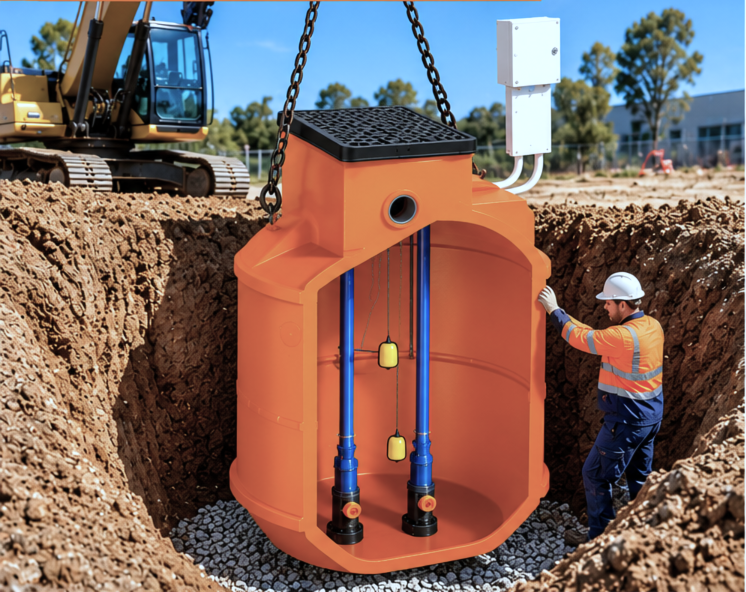
When specifying a water storage tank in South Australia, capacity, location and initial cost are only part of the equation. Local soil and groundwater conditions can have a significant influence on the durability and whole-of-life performance of a tank installation.
This is particularly relevant in South Australia, where salinity is a recognised environmental and infrastructure issue. The South Australian Government notes that many of the state’s soils are inherently saline and that salinity can affect infrastructure including roads, sewage systems and buildings.
For engineers, consultants, contractors and asset owners, this raises an important question:
How does a traditional concrete tank compare with a Fibre Reinforced Plastic (FRP) tank when installed in a saline South Australian environment?
Understanding South Australia’s Salinity Challenge
Salinity is widespread across the state. The Department for Environment and Water identifies both natural and human-induced salinity, with much of South Australia’s agricultural land underlain by saline groundwater. Where groundwater is shallow, capillary action can carry salts towards the surface.
The South Australian EPA reports that approximately 1.5 million hectares of cleared agricultural land is affected by watertable-induced dryland salinity, with the Upper South East and parts of Eyre Peninsula particularly affected.
It also affects Adelaide’s built environment. Engineers Australia has highlighted soil and groundwater salinity and its impact on housing and infrastructure in South Australia, including salt attack damage to reinforced concrete.
How Can Saline Soil Affect Concrete?
Concrete is a strong, proven material and, when engineered for its exposure conditions, can provide a long service life. Saline environments, however, need extra consideration.
Concrete is porous at a microscopic level, so salt-laden moisture can migrate into it. Depending on the salts present, concrete quality, reinforcement cover and cracking, this can contribute to deterioration over time.
Chlorides are a particular concern for reinforced concrete. If enough reach the steel, they can trigger reinforcement corrosion, and the expanding corrosion products can cause cracking, delamination and spalling.
Other salts, such as sulfates, present different durability challenges depending on concentration and conditions.
This does not make concrete unsuitable for South Australia. It means concrete tanks in aggressive soils must be designed specifically for their exposure environment, with the right concrete specification, reinforcement protection, waterproofing and joint detailing.
This gives properly specified FRP an important advantage in saline environments:
It does not rust.
FRP can be manufactured to resist water, salts and a wide range of corrosive environments, with resin systems available for continuous exposure to fresh and salt water. The resin still needs to be selected to suit the specific chemical environment and operating conditions.
1. Greater Resistance to Saline Environments
For South Australian projects, corrosion resistance is one of the strongest arguments for FRP. Correctly specified FRP does not suffer reinforcement corrosion in saline conditions, which is particularly valuable for sites with:
- Saline soil conditions
- Shallow saline groundwater
- Coastal environments
- Agricultural areas
- Sites with aggressive ground conditions
Tank material selection therefore needs to consider not just what is being stored inside the tank, but what the tank may be exposed to externally.
2. Reduced Reliance on Protective Barriers
Concrete tanks in aggressive environments may need specialised mixes, increased reinforcement cover, membranes, coatings or waterproofing. These work well when correctly designed and maintained, but they add components to the system.
With FRP, corrosion resistance is inherent to the composite itself rather than relying on a surface coating to protect steel beneath it – which can simplify the corrosion-protection strategy.
3. FRP Can Provide Long-Term Durability
Corrosion resistance matters most when assessing whole-of-life cost. A lower purchase price doesn’t necessarily mean a lower lifetime cost.
The complete equation should consider:
Purchase + transport + installation + structural requirements + corrosion protection + inspections + maintenance + repairs + expected service life.
SA Water’s engineering requirements recognise FRP as a tank material and require FRP tanks to maintain UV resistance, chemical resistance and material properties throughout their design life. In other words, FRP shouldn’t be chosen simply because it is “fibreglass” – it should be engineered for the project’s actual operating and environmental conditions.
4. Lower Weight Can Simplify South Australian Projects
FRP tanks are also significantly lighter than equivalent concrete structures, which can help during:
- Transportation to site
- Crane and lifting operations
- Installation
- Structural design
- Restricted-access installations
- Building refurbishments
Sectional FRP panel tanks can be transported as individual components and assembled on site – ideal for regional projects or where a large prefabricated concrete tank would be difficult or impossible to position.
5. Greater Flexibility for Commercial Buildings
Plant space is often limited on commercial and building-services projects. Sectional FRP tanks can be configured to suit the available footprint and required storage volume.
This makes them well suited to applications including:
- Commercial developments
- Hospitals and healthcare
- Hotels and accommodation
- Data centres
- Industrial facilities
- Fire and process-water applications, where appropriately designed
Instead of designing the building around a large monolithic tank, a modular tank can often be configured around the building.
6. Salinity Isn’t the Only Soil Consideration in South Australia
Not all South Australian soil is the same. Some areas face salinity, while others experience acidity, sodicity, waterlogging or a combination.
For example, the South Australian Government reports that approximately 2.5 million hectares of cropping land currently has acidic surface soil or is close to becoming acidic.
Many soils also drain poorly, particularly over low-permeability clay subsoils, and seasonal saturation can affect how moisture and salts interact with buried or ground-level infrastructure.
That’s why a geotechnical and environmental site assessment matters. Knowing what will actually be in contact with the tank should guide the choice of material, foundation, anchoring, drainage and corrosion protection.
Concrete vs FRP in Saline Conditions
| Consideration |
FRP Tank |
Reinforced Concrete Tank |
| Resistance to rust |
Excellent – FRP itself does not rust |
Steel reinforcement requires protection |
| Saline environment |
Can provide excellent resistance with correct resin selection |
Requires appropriate exposure and durability design |
| Tank self-weight |
Low |
Very high |
| Transport |
Relatively straightforward |
Heavy transport/lifting may be required |
| Modular installation |
Excellent with sectional systems |
More difficult |
| Restricted access |
Well suited |
Can be challenging |
| Protective coatings |
Application dependent |
May be required depending on exposure |
| Cracking |
Possible if damaged or incorrectly designed |
Structural/shrinkage cracking must be appropriately controlled |
| Underground applications |
Must be specifically engineered |
Well established when appropriately engineered |
| Whole-of-life maintenance |
Potentially lower in corrosive environments |
Depends heavily on design and exposure conditions |
Where Could FRP Provide the Greatest Advantage in South Australia?
FRP becomes particularly attractive where corrosion exposure and installation constraints occur together.
Take a commercial water-storage installation in an area with saline groundwater. A concrete tank can certainly be engineered for it, but the design must carefully address permeability, cracking, reinforcement protection, joints and external exposure.
An engineered FRP system offers a lightweight structure with no embedded steel, using resins selected for the expected chemical exposure – a distinction that matters more over decades of operation.
Does This Mean FRP Is Always Better Than Concrete?
No. Concrete remains a very effective tank material, particularly for underground structures, applications needing substantial mass, fire-resistant structures and projects where it integrates naturally with the surrounding civil works.
The key is matching the tank material to the environment. Where salinity or aggressive ground conditions are known risks, corrosion resistance should weigh heavily in the decision – and FRP offers a compelling alternative.
The South Australian Advantage of FRP
With salinity affecting significant areas of the state, durability is a key consideration for long-term water infrastructure. FRP offers several important advantages:
Corrosion resistance. Lower weight. Modular construction. Installation flexibility. Chemical resistance. Reduced exposure to reinforcement-corrosion mechanisms.
It gives consultants and engineers another option for challenging environments, simplifies transport and installation for contractors, and can help asset owners reduce long-term maintenance and lifecycle costs.
The Bottom Line
The question shouldn’t simply be: “Is concrete or FRP cheaper?”
A better question is: “Which material is best suited to the conditions this tank will experience over its entire design life?”
An appropriately designed concrete tank can provide excellent performance. But where salinity, corrosion exposure, restricted access or weight are key project considerations, an engineered FRP tank system can provide a durable, flexible and highly practical alternative.
Where space utilisation and integration within the building structure are the primary constraints, an in-situ concrete solution may also warrant consideration.
Ultimately, good tank design starts below the surface. Understanding the site’s soil, groundwater and environmental conditions first means selecting a storage system built not just for today’s project, but for the conditions it will face throughout its service life.